Readings
|
The Energy Crisis and
the Small Community Part
1 - History Introduction: Arthur
Morgan, the founder of Community Service, studied, wrote about and
participated in the development of small local communities. In his myriad
books and papers, the fundamental aspects of community were analyzed and
discussed repeatedly. These writings always addressed both the pragmatic
details of the small community as well as the spiritual relationship aspects.
The practical topics included the major topics of physical setting, local
government, economics, education, religion and recreation as well as numerous
minor topics. Considering
what may be the major concern of the 21st century, energy, Morgan
had little to say. Probably at the time of his later writings, in the 1950s
and 1960s, energy was not yet a major topic. Also, Morgan by nature and
practice was a frugal individual and would not have been expected to
participate in some new societal direction, that of rampant consumption,
which to him would appear of questionable value. Possibly he foresaw the
direction that this concept of “energy” was taking the culture and, being
a brilliant engineer, could see the end result and knew modern man would have
to go through this amazing period. Morgan
wrote of the many centuries in which man lived in small communities. He
traced the long historical development that led to the existence of the
personal qualities that are the basis of society. It is interesting to
observe that the year he formed Community Service - 1940 - was approximately
the beginning of the period of rapidly increasing oil usage. Building up
energy reserves for weapons and war had already begun. Five years later, when
the war was over, computers, atomic weapons, radar, and other high tech
products had been invented. The automobile was poised to begin its role as
the “machine for the masses”. With the new freedom of movement offered by
the automobile, we see the beginning of the decline of the family farm and
the beginning of the rapid development of urban and suburban areas. Morgan
understood the need to maintain the values of small communities for the
upcoming period. His vision was acute enough to see the next 100 years as a
century in which man would first deviate from his natural state, and then
return to it. Man has moved from being a “small community animal” as
Morgan described it, to an urbanized “machine animal”. Of course this
urbanization is based on technology, without which our large modern cities
could not exist, particularly the automobile. It is
Community Services’ contention that we have deviated from the long fruitful
evolution of the small community which gave us the values and skills to lead
a sustainable way of life. Our deviation has been away from the diversity and
cooperation of the small communities to a centralization and lack of
diversity that has extended from our own nation to the world in the form of
modern globalization. The results we see include more and more inequity,
violence, personal alienation and environmental destruction. Competition has
replaced cooperation. Our culture, as a whole, has chosen material goods
based on the abundance of fossil fuels rather than any more equitable or
thought provoking option. To use a Christian metaphor, we have chosen to
serve Mammon rather than to serve God. Material wealth and possessions, and
those machines that provide them, have become our religion, our new focus of
worship. In his
book Geosources, Walter Youngquist equates our use of fossil fuels to
having slaves. This is an excellent metaphor. Just as American slaves allowed
the development of a Southern aristocracy, so has our use of the energy
“slaves” contained in oil enabled a highly materialistic aristocracy,
represented by the wealthy classes in our nation. The
parallels are many. Remember that long after the Civil War men and women were
kept in virtual slavery, their labor required to meet the demand for cotton.
Only when the fuel-burning machines for cotton picking and processing were
invented was there more freedom of movement, at which time many of the former
slaves moved to Northern cities, an early example of the destruction of farms
and the urban movement of the now unemployable. Just as the slaves allowed
the development of a Southern aristocracy so has our use of the energy slaves
enabled us to develop a highly materialistic aristocracy, represented by the
wealthy classes in our nation and in other industrialized countries. As
Youngquist points out, the work provided by fossil fuels is the equivalent of
300 slaves for each person in the United States. Just as
slavery was untenable in the world so its equivalent is not tenable in our
world today. The use of fossil fuels and the subsequent exploitation of other
people by their use cannot continue forever. Much of the world’s current
tensions exist due to this exploitation. Our own nation fought a terrible war
between the North and the South to resolve the injustice of slavery. How
ironic that today those differences between North and South have been
replicated on a world level, with the United States, Europe and Japan serving
the role of the wealthy plantation owners while those countries we label
“The Third World” serve the role of our original African slaves, a
natural resource to be exploited. Resolution As in
many cases in society’s history, as well as in our personal lives, we see
revolutionary change arising from a sense of justice. The old saying, “My
strength is the strength of ten because my heart is pure,” rings true with
many people. Humanity has proven it has the capacity to fight and work long
and hard if their cause is just. In
the case of the industrialized powers versus the rest of the world, the cause
is not just. This is provable in two ways. First is that the benefits of the
burning of fossil fuels have not been equitable. Fossil fuels are a finite
legacy from the long ago past which, if they are to be burned, should benefit
all. This has not occurred – rather, those who already have oil use it to
guarantee their access to more, giving rise to the increasing inequities
around the world. Secondly,
the miracle that was presented to us has not been used in moderation. Rather
than being satisfied with this undeserved gift of “energy slaves” to do
our bidding, we have become greedy for more and more. We are ignoring the
damages we are doing to the natural world and, worst of all, ignoring the
needs of future generations as we use up these resources, resources that took
billions of years to make, in less than two centuries. This has earned us the
enmity of the majority of people in the world, and the active hatred of some
of those, who are now dedicated to our destruction. It will inevitably earn
us the enmity of our children and grandchildren, those who will inherit a
depleted world. Armageddon
or Depletion? What
happens when the industrialized nations begin to feel the pinch of depletion?
One possibility of resolution is warfare on an enormous scale. The
protagonists would be the wealthy West, basically the US, Japan and Europe
(the G7), against the third world. Demographically, this would pit the
wealthier 1 billion against the poorer 5 billion of the world. The attack
against the World Trade Center and the Pentagon, and the subsequent response
against Afghanistan, could be the opening salvos in such a war, much like the
attack on Pearl Harbor or the assassination of Archduke Ferdinand prior to
World War I. The two sides are not fully clear, and the battle may not be
simply one between nation states. Another
possibility is that we will simply use up the resources over which we might
do battle. The events of 9/11/01 have led Americans to become more aware of
the larger world around them. Suddenly oil is no longer something to be taken
for granted. We now know where it comes from and something of its history. As
one studies the subject more, there is a dawning realization that oil, as
well as natural gas, is finite. We cannot burn oil forever at the rate we
have in the last 60 years. Certainly, we assumed that what we call our
“lifestyle” would go on in some form for at least centuries or multiple
generations. And somehow, we thought science would find some other resource
that would last forever. It is that unstated assumption which drives our
lives and also which drives our desperation since, educated and scientific as
we are, we can see that such a dream is not possible. Depletion
Driven Decentralization To
those of us who love small community, the news is not all bad. We have seen
the suffering caused by the urbanization of our country and by our modern
“lifestyle”, and we have seen the emptiness of lives devoted to
consumption, rather than to caring. We look forward to the reversal of the
trend that moves people from country to city and from cooperation to
competition. We regret the suffering that may occur with the transition but
have the hope that the transition can be quick and the rewards well worth it.
And, one of the greatest rewards of living in a small sustainable community
is the realization that our way of life is not doing great harm either to
other people on the planet or to our children and their children who will
replace us. Basic
Facts and Conclusions: The
basic facts are simple: 1.
We have burned about half the available “cheap” oil during the
period of the 20th century, most of it in the last 60 years. 2.
Because of an increase in population along with an increase in per
capita usage, the remainder will be gone in far less time, certainly less
than 40 years. 3.
The second major fuel, natural gas, will follow a similar depletion
pattern. 4.
There is no feasible replacement for “cheap” oil and natural gas
that will maintain the quality and quantity of energy required to maintain
our “standard of living”. Note
that the reference to oil is to “cheap” oil. That refers to oil that is
easily produced, either by flow from the oil reservoir or by pumping. There
are other classes of oil that can be produced by complex and expensive
methods. However, the changes to our society will occur when the “cheap”
oil is depleted, even thought there will remain much expensive oil that will
be available for some decades. In addition, synthetic oil can be manufactured
from coal. These longer-range sources will be expensive and polluting and
cannot maintain the standard of living that was attained with “cheap”
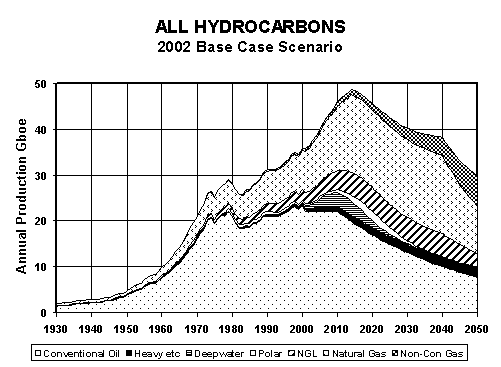
oil. The
following chart illustrates the situation.
This
leads to three conclusions: 1.
Within this decade or the next one, shortages will begin appearing and
fuel prices will increase, leading to a long term and continuous decline in
our material standard of living. 2.
Our urbanized way of living, particularly our use of the automobile,
can no longer be viably sustained and our society will decentralize,
localize, and become more rural, reversing the flow from country to city that
has occurred in the last 60 years. 3.
The results of
the ruralization that will occur will not resemble the life that existed
prior to the urbanization period. As Arthur Morgan pointed out, societal and
technological advances can be applied to small communities as easily as to
large urban ones. Measuring
Energy Resources It is
difficult to understand the facts concerning the discovery and burning of
fossil fuels. The power industries based on oil, natural gas, nuclear power,
coal and hydroelectricity are exceedingly complex. The engineering projects
that provide these resources are marvels to behold, including huge dams,
conventional power plants, petrochemical plants, nuclear power plants,
pipeline systems, electrical transmission networks, ocean oil drilling
platforms, and oil tankers. The related sciences are also complex, both in
theory (such as nuclear physics, geology, and electrical/electronic
engineering) and in practice (oil discovery, power plant construction, fuel
distribution). Decades of scientific development and practical experience in
building enormously complex structures have led to an industry that is huge,
well funded, complex, innovative and practical. Attempting to understand it
requires dedication, reasonable intelligence and hard work. Yet
today, for all our vaunted knowledge and education, the most basic facts
relative to depletion are not easily obtained. The standard media sources
such as television or newspaper articles offer widely disparate points of
view as well as misinformation and disinformation (deliberately misleading
propaganda). The result is total confusion. Miracle
options are presented as just around the corner. Economists are quoted as
saying that all technical problems will be solved as soon as the price is
right and new technologies can be funded. Any suggestion of measuring or
trying to estimate depletion rates is criticized based on the claims, rarely
substantiated, that previous measurements were not totally accurate. And, any
concern about this impending disaster is immediately countered with visions
of amazing new technologies ranging from mining the moon to generating free
energy from sea water. This
response is not unexpected. In the 20th century, we have created a
culture and nation that is truly astonishing, achieving dreams previously
impossible in the history of man. And yet, as impressive as it is, it is also
extremely vulnerable. The indications are that there will be a major
reduction in the material standard of living, should the predictions of
natural fuel resources prove accurate. To those committed to that way of
life, it will certainly appear to be tragic. To those who do not believe that
the material standard of living was worth the destruction of a centuries-old
way of life, based more on cooperation and community than on competition and
exploitation, the change will be welcome. Whichever, the case, accuracy in
terms of resource availability and usage will clarify the reality of
situation for all viewpoints. Talking
about Energy As with
the claims of infinite resources, the claims of depletion need to be
understood and justified. It is difficult to understand and evaluate
different points of view, mostly because of the emotional and highly charged
nature of the situation. Most positions are presented from the position of
needing to convert others to one’s point of view rather than to explain.
The discussions of energy have been in the media for decades and yet there is
not much additional clarity about the situation. Probably well over 90% of
all media information is simply a rephrasing of something that has already
been said, but with a “spin” that makes it appear new. The “renewable
energy viewpoint” in the media has presented pictures of windmills
generating electricity without giving a simple chart regarding the efficiency
of wind energy. Such a chart, showing total contribution of windmills to the
energy situation and the growth rate of that contribution over the several
decades that they have been under development would show it to be unfeasible.
Similarly, those proponents of inexhaustible fossil energy repeat for the
thousandth time that there are trillions of barrels in oil shale without ever
presenting a simple chart of shale oil produced to date along with the cost. This
layer of obfuscation is greatly troubling in the debate about oil depletion.
Without a prior agreement regarding the meaning of certain language, there
can be no additional clarity to the average person. That person merely hears
one claim after the other, none adequately substantiated, and eventually, due
to simple exhaustion, will either pick a side and become an exponent of a
position, or else will simply ignore the situation. There
are several key measurements and definitions that form the basis of any
discussion about energy and energy sources. They include the following:
MBOE - Millions of barrels of oil equivalent
EROEI - Energy Returned on Energy Invested
EPEC - Energy per capita Detailing
the definitions for these concepts helps us talk about oil. If we agree on
definitions, we can use these terms to provide measurements of the oil
situation. In more popular terminology, it will provide the “bottom line”
information we need to make decisions. Each of these is summarized below. MBOE The
most significant contribution to an accurate discussion that can be made is
to determine accurate ways to measure both resources and usage. Any study of
energy use will uncover a myriad of ways of talking about energy, including
measures of barrels, gallons, millions of barrels, millions of barrel
equivalence, thousand cubic feet, trillions of cubic feet, joules, calories,
watts, kilowatts, BTUs, etc. It is extremely difficult to converse and
understand issues when measurements are inconsistent and change. A single
measure is often necessary and, to simplify conversation and analysis, other
measures should be converted to this single measure. For
this discussion, we will measure with the standard of millions of barrels of
oil equivalence (mboe) and the time span will be per year. Thus a driver of a
car who drives 12,000 miles per year in a car with average gas mileage of 30
miles to the gallon will be said to use approximately 10 mboe, calculated by
dividing the 12,000 miles per year by 30 and dividing that result by 42 (the
number of gallons in a barrel). EROEI The
second factor to introduce is the concept of net energy. Net energy is the
resulting energy available from resources after the energy to develop those
resources has been developed. For example an oil well produces a certain
amount of energy from the total amount of oil it can produce. However, there
is energy expended in drilling for the oil, pumping it, processing it and
delivering it. The energy it provides is the original energy contained minus
the energy to process and deliver. The measurement used is termed EROEI,
which stands for Energy Returned On Energy Invested. EROEI
for oil ranges between 8.4 and 11.1, meaning it takes one barrel of oil to
produce 8.4 to 11.1 barrels of usable fuel. This barrel of oil is used for
pumping the oil from the ground, refining it and transporting it to where it
will be used. Natural gas ranges from 6.8 to 10.3. EROEI for coal being used
to generate electricity is 2.5. Coal for other purposes may be different.
Finally, the EROEI of hydrogen is less than 1, meaning it costs more energy
to produce it than it provides. Ethanol, made from corn grown and processed
in the United States, also has an EROEI of less than 1, meaning it costs more
energy to develop it then it provides. Making
products with EROEI less than 1 are not simply ridiculous mistakes. One
reason is to change the form of the energy. Natural gas can be used to make
the fertilizers that enable the corn to grow and can also provide the energy
for processing corn. Assume it takes 1.5 gallons of ethanol equivalent in
natural gas to provide one gallon of ethanol. The ethanol can be used to
drive a car while the natural gas cannot. In this country we have more
natural gas available to us then oil. So if we need oil equivalency, and have
the natural gas, then we may not care if it is inefficient. In another
country there would be a different rationale for the process or possibly in
that country the conversion would not offer benefit. EPEC EPEC is
the abbreviation for Energy Per Capita. This is a measurement that has long
been needed. It can be a measure to show the inequity that exists in terms of
the availability of fossil fuels to people in the world. As fuels become
scarcer, allocations of fuel will have to be made, either by force or by
agreement. Since the US is now invincible as a military force, it can take
fuel resources it wants from any country without the means to deliver nuclear
weapons. Alternately, it can set the prices for the market. The target for
such actions could be the OPEC nations who will have most of the oil and
which include the major Mid East producers. However,
such actions can only delay the inevitable, and the sooner we accept the
eventual depletion, the sooner we can make the choices to forestall it. The
EPEC in that case will be a measure of the moral standards of the nation more
than anything else. Source
vs. Form of Energy The
final important concept is to understand is the difference between the source
of energy and the form of energy. Oftentimes, the term “carrier”
is used to distinguish a source from the form. In some cases, this is very
clear. Most people understand that a battery is a form of energy, created by
charging it from some fossil fuel generator. In other cases, this is less
obvious. Electricity is certainly viewed as energy, but it is a form,
or a carrier. It represents energy produced through fossil fuels, nuclear
plants, wind power, and hydroelectric or hydro energy. One of
the major areas of misunderstanding is represented by the claim that electric
cars are clean and do not pollute. This is true but only in a very limited
sense. One can choose to use oil to drive a car and discover the exhaust is
polluting the atmosphere. Alternatively, one can build a power plant that
generates electricity and which pollutes the atmosphere at the location of
the plant. The electricity that is generated can charge batteries for an
electric car some miles away. At the site of the car while charging and while
driving there are no apparent emissions and the electric car is termed
“green” or “clean”. However at the site of the generating plant, the
pollution is extreme. After a few days of wind and distribution of the
pollutants from either the group of cars with gasoline engines or from the
centralized plant which provides “clean” energy to the electric cars as a
form of energy. Part
2 - Misinformation Major
Philosophical Dangers There
are four major philosophical errors, or errors of belief, that are often in
evidence in any discussion of oil. 1.
Science will
always find a replacement 2.
When prices rise, new energy sources will emerge. 3.
Energy is infinite 4.
There are enough resources to last centuries Science will always
find a way This
belief persists with no evidence. There are many things science has not
provided after many decades of trying, such as a cure for cancer. In spite of
the inherent and serious dangers of radioactive materials generated from
nuclear power plants, science has found no way to change their rate of decay.
Nor has science found a way to turn lead into gold. Fusion is still a
theoretical way of generating electricity, with no meaningful progress being
made. At the
same time, science can be credited with causing severe problems, which they
have been unable to alleviate. The invention of fluorocarbons destroyed much
of the ozone layer. The invention of trans-fats has led to major illnesses
and poor health. The use of technology in agriculture has been destroying and
continues to destroy the topsoil from which all the plants that keep us alive
grow. When prices rise,
energy is created This is
the economist’s myth. It ignores the cost of energy expended to get
additional energy. As prices rise, because costs rise, then the cost to find
new sources of energy also rises and a source that may have been economical
to develop at an earlier cost is no longer feasible at the newer costs. It
takes energy to get energy. Energy is infinite The
best example of the error of this thinking is the United States. We become
more dependent each year on imports from the rest of the world. In the 1960s
the US was the leader in reserves and production. Now, after a short time,
the oil reserves have been badly depleted. There is energy enough
for thousands of years.
Myths
are false views of the world that enable us to continue our actions without
any qualms of conscience. In the world of mental health, they represent the
statements we make which allow us to remain “in denial”. Many of the
statements made are at best irresponsible and at worst malicious. Media
statements in particular are notorious for inaccuracy. Some of these
statements have been proven to be false, yet there is little hope in
eliminating them, since the purpose of the media is not to educate but to
motivate - this motivation typically being to buy something from an
advertiser. A
recent article in the September 30, 2002 of Business Week on hydrogen energy
contains the following paragraph: “There’s plenty of unconventional oil in the ground too.
Tarlike bitumen desposits in sandy soil in western Canada and Venezualea
contain as much oil as all the conventional deposits in the Middle East.
Canada’s Suncor Energy Inc. produces light, sweet crude at an operating
cost of just $8 a barrel, vs. a market price of $29 a barrel. And production
costs keep falling.” Since
the US is buying half their oil at $29 per barrel from OPEC suppliers, one
must either believe oil companies have overlooked this source of oil, or that
possibly the statement is not true. The reality of non
conventional oil sources Non-conventional
oil is oil that has been produced from oil shale, tar sands, or heavy oil.
These are second tier opportunities, requiring a higher level of
technological expertise in hostile environments for relatively small
deposits. Shale
oil – Shale oil
is distilled from kerogen. It’s not actually oil; instead it’s more like
coal. The most advanced facility processing shale oil is in the Piceance
Basin of Colorado. The process requires large volumes of water and generates
large quantities of waste. In fact, waste volume is actually greater than the
original volume of material since the materials swell under processing. There
were major efforts in developing shale oil after the 1970s oil crises, but
that development has now withered away. Tar sands, Bitumen Oil and Heavy Oil -The largest deposits of this type of resource are
the tar sand deposits of Athabasca in Canada, and the heavy oil deposits of
the Orinco area of eastern Venezuela. Each is estimated to contain over 1
trillion barrels of oil. The most advanced processing is done in Canada,
where tar sands are mined in open pits. The mining process is to first strip
off the “overburden”, or, material that does not produce oil. The
material is separated with steam, hot water and caustic soda, and then
diluted with naphtha. The result is centrifuged and further treated. The
process is economically viable and produces oil. Smaller deposits are the
Aldan and Siliger deposits in the Former Soviet Union. In Venezuela, the
heavy oil is extracted using steam stimulation and chemical dilutes. The
quality of the resulting product is low. Each of
these operations is producing about 500,000 barrels per day. Combined, these
produce about 1 million barrels per day compared to 70 million barrels
produced per day of conventional oil. Part
3 - The Fantasy Solution In our
culture, we begin to teach our children to fantasize at a very early age.
And, oddly enough for people who love their children, at the same time we
begin lying to them. The first and important character we present to our
children outside of our immediate family is Santa Claus. We create a mythical
character, give the character extraordinary powers, and encourage our
children to behave in a way to be pleasing to the character. It is not too
dissimilar to worshiping a god, except with Santa Claus there is no
punishment for misbehavior - merely a withholding of gifts. Later we add the
Easter Bunny and the Tooth Fairy. Television
offers a large number of characters to supplement these mythical figures in
the form of animated comic strip characters. The Walt Disney corporation and
its competitors create a rich fantasy world of happy, often powerful and
frequently violent cartoon characters which children observe hour after hour
for many years. Later, when these children are adults, their fantasy
characters have human bodies, albeit extremely attractive and unique bodies,
and celebrities replace comic strip characters. Our
fantasies flow over into our everyday life. Our culture is a consumer
culture, meaning the highest value is the acquisition of material goods. We
observe hundreds of advertisements per day, tens of thousands per year,
promising us wonderful things if we buy their products. We do not necessarily
believe what is said in some scientific sense, but we are motivated by the
desires created and rationalize our subsequent purchase. Inevitably
in this type of culture, all our communication becomes the same. In business,
we are taught that marketing is the number one required skill. In recent
years, it has become in vogue for non profits, universities, churches and
government agencies to develop their own marketing skills. We are importing
wholesale our business values to the non-business sectors of our society. This
cultural tendency results in new ideas being sold rather than explained. The
wish is to market rather than to educate. Nowhere has this been more apparent
than in the recent debacle associated with the World Wide Web and the
Internet. Until recently, the nation had something we called the
“economy”, that field of knowledge dealing with the goods and services of
society. In the 1990s, adjectives were added to the word and presumably
described completely new ways of naming, evaluating and deciding on goods and
services. The most popular included:
The Next Economy
The New Economy
The Internet Economy
The Information Economy Each of
these attempted to describe a very radical change in society. Classic
economic concepts of profit and loss were rejected. New ways of discussing
the classic profit and loss statements were created. Internet companies by
the thousands were started. Young, so-called “geeks” replaced
experienced, more conservative workers. Hundreds of billions of dollars were
invested in these “new” ideas. Capacity for computer connections was
increased by more than two orders of magnitude. Former Vice-President Al Gore
made the Internet the key point of his role in the Clinton administration. In the
early part of the 21st century, these “economies” have proven
to be more fraudulent than anything else. Like elixirs that would cure all
diseases, they had no substance. Much of the creative bookkeeping was simply
fraud. The older economic principles proved to be necessary and valid.
Information, particularly Internet information, showed itself most profitable
in the area of pornography and violent video games. E mail became perverted
by spam. And yet, despite the
hype, people continued to attempt to go to good schools and universities with
good teachers and good textbooks. People still found that face to face
encounters were preferable to computer interaction. As the
bankruptcies and scandals occurred, much disillusionment occurred. Some
people lost money gambling in the market. Others lost jobs. But overall, the
New Next Information Economy did not touch the lives of the majority of
people. At best, it simply dominated the media for a few years. At worst it
involved expensive spending on computers and computer connections for both
businesses and consumers. Nonetheless, it was a major distraction from the
real problems facing society for 5-7 years and its demise may take the
nation’s attention for a few more years. The
Next Fantasy - The Hydrogen Economy As the
stock markets declined and the number of CEO scandals increased, the Hydrogen
Economy began to make its appearance. Suddenly we learned that hydrogen, one
of the components of water, would transform our lives to an even greater
extent than the Internet Economy was supposed to do. Concerns about resource
depletion, global warming, ozone holes and acid rain were to be relieved in a
single stroke. Whatever our problems, it appeared that hydrogen, along with
its sibling, the fuel cell, would resolve them. Frighteningly similar to ads
for detergents on TV, the components are “new” and have amazing powers.
Hydrogen will even bring peace to the world, since the classic struggle for
energy resources will be eliminated. The
tendency to market rather than educate is exemplified by one of the first
basic statements made about hydrogen, that it is “the most abundant
material in the universe.” This may be true of the universe, which is quite
large and most parts of which we have little knowledge. But our main interest
is our earth, and on earth hydrogen is not the most abundant material. It is
actually the ninth most frequent element. 11% of the earth’s material are
hydrogen. This
is a significant point. If hydrogen proponents will provide irrelevant data
in order to attract us, will they also provide misinformation in other forms? Misinformation
does not necessarily consist of lies. One can misinform by intentionally
withholding information. It is not a lie that hydrogen is the most abundant
form of material in the universe. However, the intention is to give a sense
of limitless abundance. One is not misinformed if one is given the percentage
of hydrogen in the area one expects – our planet. There
are two other common misstatements about hydrogen that can mislead. The first
is that hydrogen is not a fuel but a carrier. And the second is that hydrogen
is a “clean” fuel - it has no emissions. Earlier
we discussed the difference between form and source, using electricity, a
carrier, as the example. In his book, Tomorrows Energy, (page 8)
author Peter Hoffman says “Hydrogen is not an energy “source”, a mistake still
made fairly often by otherwise sophisticated, well-informed people. That is,
it is not primary energy (like natural gas or crude oil), existing freely in
nature. It is an energy carrier - a
secondary form of energy that has to be manufactured (like electricity, which
doesn’t exist freely in usable form either.) Hydrogen can be generated from
many primary sources - an advantage in itself, since it reduced the chances
of creating a hydrogen cartel similar to OPEC (which, for a while at least,
was able to dictate global energy prices).” As a
prime supporter of hydrogen, Mr. Hoffman is “selling” us. From his
sentence one can determine that a carrier is a substance that has to be
manufactured. Later he tells us that currently hydrogen is manufactured
principally (98%) from natural gas. In other words, at least in current
practice today, hydrogen is a substance that is manufactured from natural gas
- a fossil fuel. Other examples of manufactured fuels are synthetic oil,
which is manufactured from coal and town gas, a gas also manufactured from
oil. A “carrier” is a better word than “a gas manufactured from fossil
fuels” since the reader might immediately wonder how hydrogen replaces
fossil fuels if it is manufactured from them. One of
hydrogen’s greatest attractions is that it is supposedly a “clean” fuel
- it creates no emissions at the time it is burned. This is absolutely
correct. What is not said (misinformation by omission) is that emissions are
created at the time it is manufactured. Fossil
fuels in general are given the overall name of hydrocarbons. This means that
the molecules of the fossil fuels are made up of some combination of hydrogen
and carbon atoms. Gasoline, a hydrogen/carbon mix, when burned with oxygen
from the air, utilizes the power from the hydrogen atoms. The carbon which it
also contains is a waste product of this burning in the form of CO2, the
familiar greenhouse gas associated with global warming. Natural gas follows a
similar process. What
happens in the case of hydrogen? Since natural gas is also a hydrocarbon,
what happens to the carbon atoms when hydrogen is manufactured from the
natural gas using a process called “steam reforming”? The carbon atoms
that result from the process are released into the atmosphere in the form of
CO2 - just like the process of burning gasoline. The
next paragraph after the one referenced above reads: “Today, hydrogen is made (that is, extracted) mostly from
fossil fuels. But efforts to clean up these fuels (to “decarbonize” them,
in the jargon of energy strategists of the 1990s) will increase. To
de-carbonize really means to adapt techniques long used in the chemical,
petroleum, and natural gas industries to strip out the carbon or CO2 and
store (sequester) it out of harm’s way, leaving hydrogen.” My dictionary defines “sequester” as “to set apart: segregate” The only time I can recall that word being used is in
reference to “sequestering the jury”, that is to put a jury in a room
with no influence from outside. Further reading from Mr. Hoffman’s book
shows that he is “sequestering” the CO2 by burying it in the ground In a similar way, the nuclear wastes from power plants and development of
nuclear weapons are to be “sequestered” deep inside a mountain in Nevada.
And prior to this “sequestering”, nuclear and other toxic wastes were
“sequestered” in deep parts of the ocean. It is the intention of these
“clean hydrogen” proponents to bury the CO2 in the reservoir spaces now
emptied of natural gas and oil. Hopefully all the sequestered wastes from our
generation of energy usage will never be disturbed by geological changes. Many of
the proposals for hydrogen cars include the proposal to manufacture the
hydrogen “on board”. That means there would be a small reforming plant as
part of the car. (Reforming is the name of the process that removes hydrogen
from methane - the main part of natural gas.) Gasoline or some other fuel
would be processed by the reformer, and the output of hydrogen would then
enter the fuel cell to generate the electricity to drive the car. This design
replaces the “dirty” internal combustion engine with a “dirty”
reforming device which is generating hydrogen for “clean” burning in a
fuel cell. The
mind boggles at the thought of explaining how the car can be non polluting
with one device (the fuel cell) generating “clean” electricity from
hydrogen while 18 inches away another device (the reformer) is creating
pollutants by extracting hydrogen from a fossil fuel (and generating
pollutants) for the clean device. The
counter to this argument is to introduce another term – transition fuels.
The natural gas from which the hydrogen is made is a “transition fuel”,
only to be used until technological advancement in the distant future allows
hydrogen to be manufactured (or extracted) from water using electricity. In
this case, there is no carbon involvement and only oxygen is released into
the environment, presumably with no harmful side effects. But today,
electricity is generated from that same natural gas that is being “saved”
by using natural gas in the steam reforming process. As we have seen above,
electricity is simply a carrier for other energy sources, mostly fossil
fuels. Obviously
one can make a car that runs on natural gas or one that runs on synthetic gas
made from coal. Adding the hydrogen interim conversion is questionable.
However, there is no way to create a small nuclear plant to operate a single
car. Thus, there is a case where nuclear power can be used for the
electricity to create hydrogen which can then be placed on board a vehicle in
some form or the other. Few hydrogen proponents want to be caught proposing
nuclear power plants simply to make hydrogen to run cars. One wonders how
many thousands of such plants would be needed to supply the hydrogen for the
almost one billion cars currently on the planet. To
quote Mr. Hoffman further: “In the future, hydrogen will be made from clean water and
clean solar energy - and just possibly (though it seems unlikely from the
anti-nuclear perspective of the late 1990s from “cleaner” versions of
nuclear energy, including fusion.” Since
natural gas could simply be burned directly and propel a car, without the
need for the extracting of the hydrogen, it is not clear if there is a need
for a “hydrogen” economy if there are sufficient fossil fuel resources.
If there are not going to be sufficient resources, then it seems that the
hydrogen economy should be focused solely on the electrolysis process,
acknowledging that there are some limited applications where hydrogen is a
more useful fuel such as mining machinery and fork lifts in enclosed
buildings. The
strategy of proponents of the Hydrogen Economy is questionable. If hydrogen
is simply a different form for the use of natural gas, it may be easier to go
directly to natural gas fuel tanks in passenger cars, which already exist. If
hydrogen as a carrier is justified on an anti-pollution basis through the
successful sequestering of waste CO2, then it is simply one technique for
reducing CO2 in the atmosphere. The huge risk here is the possibility of
several decades worth of sequestered CO2 being released at one time in case
of some series of accidents or geological changes. If hydrogen is based on
the use of electrolysis from water, then the sources of the electricity must
be identified, which obviously will be either nuclear power, with the safety
concerns and generation of long term nuclear waste, or which will be solar
power. In the
case of solar power, the hydrogen economists have as yet failed to devise a
model of the cost and amount of solar photovoltaic cells needed to provide
the electricity for the electrolysis of water to make hydrogen. At this time,
the history of solar and wind power is spotty at best, since the technologies
have existed for many decades and the record of application and cost
effectiveness have not been attractive. The
Hydrogen economy has the familiar patterns of another recent techno-fantasy
solution. We earlier discussed the death of the electric car. However, in
1996, rave reviews were similarly popular for the electric car, with several
manufacturers building the cars. These cars were announced with great
fanfare, when a few hundred or at best a few thousand were manufactured out
of a total of 17 million cars produced annually in the United States. Within
six years beginning in 2000 and ending in 2002, all electric cars were
withdrawn from the market. Part of
the reason these cars were built was political, responding to California
laws. The technology of batteries, generators and electric motors were well
known at the beginning of the effort and it was fairly predictable what the
results would be, considering battery weight, charging time, distances
between charges, temperature effect on batteries, etc. A
parallel situation exists today. The process of extracting hydrogen is well
established and a major hydrogen extraction industry exists with known costs
and technologies. Fuel cells have been in existence for decades.
Concept cars running on fuel cells, either hydrogen or some other substances
have been in existence for decades - Mr. Hoffman’s book places the first
one in 1959. The US space program has utilized hydrogen in batteries for
electrical power since the 1960s. It seems somewhat overdone to speak of
technologies so long established as new and exciting. A better and more
honest approach would be to acknowledge the extremely difficult tasks of
providing an alternative to the current energy system. The analogy to the
electric automobile is not an unreasonable one. Political
Decisions In the
case of energy, certainly many decisions are political, meaning they are made
in some way that is beneficial to some constituency or not easily justified
on a purely rational basis. For
instance, ethanol is developed under government subsidy in some parts of the
Midwest. The ethanol EMROI is less than one, meaning it is not effective. If
one considers this as a political tradeoff that served some purpose rather
than an act of malfeasance or incompetence, then much of the emotionalism can
be avoided. A
second example is the electric cars built by GM, Honda, Toyota and Ford.
These were done in response to demands from California legislatures to
balance out other, more heavily polluting cars. In this case, the cars were
hyped by manufacturers and media as a panacea. A few short years later, they
were dropped from the market after less than a thousand cars were produced.
The cost of each car was probably in the range of half a million dollars, if
one prorates the R and D cost across the units manufactured. Response to the
cancellation included indignation from the few hundred owners that had driven
the cars as well as severe criticism from environmental groups. Yet this was
partly a reasonable political decision and partly a research and development
effort to test feasibility. Instead of strong negative reactions and
accusations of deceit and treachery, it is more useful to summarize the pros
and cons of the effort. Accepting political decisions for what they are
without strong reactions positive or negative will remove a major barrier to
understanding. Part
4 - An alternative fantasy - the small community Today,
the trend to globalization dominates foreign policy and political philosophy.
Together with a tremendous fixation on technology, it defines our modern
world-view. At the same time, increasing inequity, poverty and environmental
degradation are endemic in all countries of the world. An increasing GNP does
not justify the increasing societal deterioration - this deterioration being
inversely proportional to the increasing GNP, which itself is directly
proportional to fossil fuel consumption. We
suggest that the inevitable depletion will lead to decentralizing. The energy
costs to maintain a highly centralized system as the one we have created will
be too expensive to pay. Transporting food an average distance of 1200 miles
will no longer be economically feasible. Driving a 4000 pound car 50 miles
round trip to work five days a week will also not be feasible. All aspects of
life will be decentralized and dependence on fossil fuels will be reduced. One can
view this as a gain or a loss. Cheap manufactured food will no longer be
cheap and obesity will decline. Cheap transportation will no longer be cheap
and walking will increase, resulting in an improvement in health. Automobile
accidents and their accompanying deaths and injuries will decline. Crime
rates will decline in a small community where people are known to each other.
Consumption of material goods will decline and social relationships will be
their replacement. The
changes can be construed as “going backwards” or “going forwards”. We
will definitely “go backwards” in the progress we have been making in
harming the environment. Hopefully we will “go backwards” in our
measurements of crime, imprisonment, obesity, disease, and cancer rates (the
later being correlated with industrial products manufactured largely from
petroleum). Thousands and thousands of acres of asphalt and concrete will
hopefully disappear with time. We
will “go forward” in the areas of participatory democracy. Educational
standards should improve with neighborhood schools. General well-being will
improve. All the technologies of health care, communications, architecture
and home building will remain with us in our small communities. There is,
after all, life after excessive automobile travel. Part
5 - Options We
assert that, fortunately, there is no option to decentralism. Our bias is
such that we do not want to find options to continue along the destructive
path of globalization, centralization and its associated inequity. Nor do we
believe that this is the desire of the ordinary people that make up the
majority of the citizens in this nation and in the world. Many will oppose
decentralism because many have become wealthy based on the fossil fuel
economy, for example real estate speculators in urban areas. However, the
inequity that we point out has only enriched a few at the expense of the vast
majority. Advertising,
public relations and other vehicles of the industrial corporations are a
strong force to reckon with in the transition to come. The media have told us
that freedom to consume is the greatest value of our society and for many
decades this consumption has been our unthinking habit. We have overlooked
the alienation and unhappiness that has gone with it - blinded by the lure of
our possessions. The greatest source of advertising income is from the
automobile industry and many people have defined their lives by their
automobile. Other aspects of urban living are also very seductive and leaving
them behind will not be easy. Without some external force, such trends would be too strong to overcome. But the depletion of energy resources will require change. When we can realize the pain in our lives and the hatred in the world based on the inequity of modern civilization, we will be open to seeing the joys that are available in a community of relationships, replacing the loneliness of materialism. |